Water


What is the hydrosphere?

 When the first astronauts went into space they saw that the Earth was blue. This is because three quarters of the surface is covered with water from the oceans. 

The hydrosphere is one of the layers of the Earth. It is made up of all the water on Earth.

Most of the water of the hydrosphere is salt water. 97% is water from the seas and oceans.
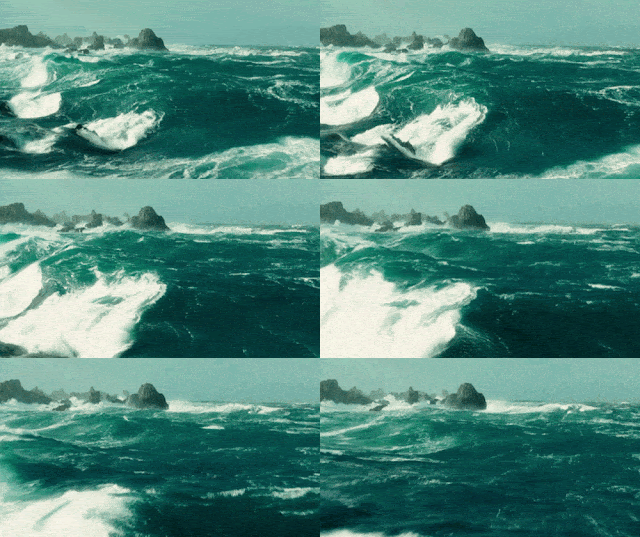


Salt water  is found in seas and oceans. 

 There are five oceans: the Indian Ocean, the Arctic Ocean, the Antarctic Ocean, the Atlantic Ocean and the Pacific Ocean. They form the salt water on the Earth’s crust.


Fresh water

 Fresh water comes from rivers, lakes and groundwater, although most of the fresh water on Earth is ice from glaciers, snow on the mountains and from the poles.


Only 3% of all the water on Earth is fresh water, the water we can drink.


Surface water and groundwater 

There are two types of fresh water on Earth: 

 Surface water: This is found on the surface of the Earth, in rivers and lakes and as ice in glaciers. 

 Groundwater: is water that is deposited under the ground. It collects from rain that falls through the soil. This water can form aquifers and underground rivers. 


Rivers 

A river is a body of water in continuous movement that flows to the sea.

 The main parts of a river are: the course, the channel and the flow regime. 

 Course. The route the river takes. It has three parts:

 1.- Upper course. The land is steep next to the source.

 2.- Middle course. The land is flatter and the river is wider.

 3.- Lower course. This is the very flat land near the mouth of the river. 

River basin. This is an area of land drained by a river and its tributaries. 


 Channel. This is the area that contains the flowing water of the river.


 Flow regime.

The flow regime is the amount of water the river carries. It can vary depending on the time of the year.


River Model


The water cycle

 Water is always moving around the Earth. We call this movement the water cycle. The water cycle takes place between the atmosphere and the Earth’s crust. 


 1. Evaporation: The Sun heats liquid water. It evaporates to form water vapour in the air.

 2. Condensation: The water vapour passes into the cold air in the troposphere. Here, it condenses into tiny water droplets and forms clouds.

3. Precipitation: The tiny water droplets form larger, heavier drops. These droplets fall from the clouds as rain or snow onto the Earth’s crust.

4. Collection: Water in the rivers goes into the seas and oceans. The cycle starts again.

                                                       Song


Water cycle in a bag


 The rivers of Spain


In Spain there are different types of rivers because they flow through different types of relief and climate. 

 Relief influences the length of rivers. Rivers are long if their source is in the mountains far from the sea. Rivers are short if their source is near the sea. 

 Climate influences the flow regime. Rivers that flow through rainy areas have abundant flow regimes. Rivers that flow through dry areas have low flow regimes. 

                                 Watersheds in Spain 

A watershed is an area of land where all the main rivers flow into the  same sea.

 The three main watersheds in Spain are the Cantabrian, the Atlantic and the Mediterranean watersheds.

 1 The Cantabrian watershed is in the north of Spain. It is the smallest watershed. All the rivers flow into the Cantabrian Sea.

 The main rivers are the Navia, the Nalón and the Eo.


The rivers have these characteristics: The channels run through deep river valleys. The river courses are short and flow over steep land because they start in mountains near the sea. The river basin is small and the relief is mountainous. The flow regime is regular and abundant because it rains all year.


2.-The Atlantic watershed is the largest in Spain. All the rivers flow into the Atlantic Ocean. 

The rivers have these characteristics: The rivers that flow across the Iberian Peninsula, for example, the Tajo, are long because they start in mountains far from the sea. They have a higher flow regime in spring and autumn than in summer. 

 In the Canary Islands there are no rivers, only gullies. Gullies are channels that carry water only when it rains. 


The main rivers are: 

The Miño: Its source is in the Galician Massif. Its main tributary is the Sil.

 The Duero: Its source is in the Iberian Mountain Chain. Its main tributaries are the Pisuerga, the Elsa and the Tormes. 

 The Tajo: Its source is in the Iberian Mountain Chain. Its main tributaries are the Jarama and the Alagón. 

 The Guadiana: Its source is on the plains of La Mancha. Its main tributaries are the Cigüela and the Zújar.

 The Guadalquivir: Its source is in the Subbetic Range. Its main tributary is the Genil.

3.-The Mediterranean watershed 

Most of the rivers have these characteristics:  They are short because they start in mountains near the sea. They flow through areas of little rain, so they have a low flow regime. In some places the climate is so dry that there are only gullies. The main rivers are the Júcar, the Segura and the Ebro. 

 1.-The Ebro is the longest river in the Mediterranean watershed. Its source is in the Cantabrian Range. Its upper course flows through areas where it rains and snows a lot. For this reason it has the most abundant flow regime in Spain. The main tributaries of the Ebro are the Segre and the Jalón.


Rivers of Spain arts and crafts


                             http://mibauldeclase-cbc.blogspot.com/2017/11/los-rios-y-vertientes-de-espana.html?spref=pi

ELEMENTOS BÁSICOS DEL DIBUJO


Los elementos básicos del dibujo son: el punto, la línea, la forma, el color, luz y sombra y textura.


Empecemos con el punto.
El punto es el comienzo de toda obra de arte..   .  .  . .

Veamos la técnica del puntillismo!


El creador del puntillismo fue Georges Seurat. Veamos un vídeo sobre él!


Reto 1: hacer un dibujo con lápiz y cubrirlo con la técnica del puntillismo (rotuladores, acrílicas,bolígrafo...)


Veamos ahora el segundo elemento La línea
La línea: es una sucesión continua de puntos.
Existen diferentes tipos de líneas:

Según su forma:


Según su posición en el espacio:


Según la relación entre si:


                                                                       fuente

Veamos un vídeo para ver los diferentes tipos de líneas.


Reto 2: busca  3 objetos donde se vean algún tipo de línea de las vistas. 
Hacer fotos a los objetos. Pegar las fotos en un documento Word. El título de este documento es: Tipos de líneas.
 (en rojo, negrita, mayúsculas y  tipo de letra que debes usar: Comic Sans  tamaño: 22)
Pega las 3 fotos y escribe debajo de cada foto el tipo de línea que aparece en ese objeto. (letra Comic Sans  tamaño: 14)


Veamos ahora el tercer elemento La Forma
Las formas: las formas se hacen con líneas.

Veamos un vídeo para ver las principales!


Reto 3: hacer un dibujo de cada una de las principales figuras geométricas.


Vamos con el cuarto elemento El Color 


Los colores transmiten emociones y sentimientos.Veamos lo que nos transmite cada uno de los colores.
                                      fuente


El azul es un color frío. Simboliza el aire y agua, por ejemplo el cielo y el mar, y la noche si el azul es oscuro. Transmite frescura, sensación de alejamiento y amplitud. Tiene un efecto calmante y sedante que favorece la meditación y el sueño. También puede ser símbolo de introversión y tristeza.


El rojo es un color  cálido. Simboliza el fuego, la sangre, el corazón, el   peligro. Transmite más calor que ningún otro color además de vitalidad, coraje y optimismo. Sirve para llamar la atención.


                                                              fuente
El amarillo es un color cálido y luminoso. Simboliza la luz, el sol y el oro. Transmite más sensación de claridad que ningún otro color además de energía, optimismo y alegría. 


El color verde simboliza la naturaleza, la primavera. Transmite sensación de descanso, armonía y equilibrio.


El color naranja simboliza el calor, luz, fuego, alegría e imaginación.Transmite sensación de energía, creatividad y vitalidad.  


El color rosa simboliza el amor, la delicadeza y bondad. Transmite una sensación de ternura.                                                                                                   fuente                                                                                                        


El color púrpura simboliza el poder, la sabiduría y el misterio.

Nos transmite sensación de tristeza y melancolía.


                                                                                                                                                                                                                                                                                       fuente

El color marrón simboliza la tierra. Nos transmite sensación de realidad.


                                                  fuente


El blanco es neutral, no se asocia a una temperatura o a un género. Simboliza pureza,  bondad e inocencia. También puede ser símbolo de paz. El blanco puro transmite más luminosidad que ningún otro color además de sensación de amplitud, frescura y limpieza. 


                                                                                                                                                                                                                                                                                                   fuente                                                                                                                                                                                         Colores primarios, secundarios y complementarios.                          

Todos los colores son combinaciones de los 3 colores primarios que son el azul, amarillo y rojo  (cian, magenta y amarillo)

Los colores secundarios, se obtienen de la mezcla de dos colores primarios: el naranja, verde y violeta.


El círculo cromático más básico tiene 6  colores: 3 primarios y 3 secundarios.


El círculo cromático más utilizado es el de 12 colores. Además de 3 primarios y 3 secundarios se añaden otros 6 colores  terciarios. Los colores terciarios se consiguen al mezclar  un color primario y un color secundario, estos son: amarillo verdoso, amarillo anaranjado, rojo anaranjado, rojo-violeta, azul-violeta, y azul verdoso.


Los colores complementarios son los que están opuestos en el círculo cromático.

Los colores también los podemos clasificar según la sensación que nos provoca: frío o calor.

Los colores cálidos están  asociados al fuego  y son  el amarillo, el naranja y el  rojo .

Los colores fríos están asociados al agua y frío  y son  el azul, el verde y el violeta.

                     
    ¡Veamos un vídeo  sobre los colores fríos y cálidos!                              


Reto 4: hacemos un dibujo utilizando solo colores fríos.


Veamos ahora el quinto elemento La Luz y las sombras

Para hacer luces y sombras en un dibujo , lo primero que tenemos que hacer es ver de donde viene la luz.
 Para hacer las sombras presionaremos con el lápiz. Las zonas del dibujo que estén más alejadas de la fuente de luz las oscureceremos.

¡Veamos este vídeo!


Reto 5: ¿puedes dibujar las sombras a estas figuras?


          Vamos con el último elemento La  Textura

Las texturas pueden ser:  
                
Visuales y táctiles.
  •  Las  texturas visuales  son las percibidas por medio de los órganos de la visión. Estas son representaciones gráficas, como fotografías, pinturas o dibujos, por lo que tienen sólo dos dimensiones, por tanto, carecen de relieve. 


Las  texturas táctiles  son percibidas tanto con la vista como con el tacto y, a diferencia de las anteriores, sí poseen volumen, por lo que son tridimensionales. Las texturas táctiles  pueden ser suaves, rugosas, lisas, etcétera.   


También podemos clasificar las texturas en:

                                     Naturales y artificiales
  • Las  texturas naturales son propias de las superficies y cuerpos que ofrece la naturaleza, por ejemplo la corteza de un árbol, la piel del elefante.

                        fuente


  • Las texturas artificiales provienen de aquellos objetos y superficies que fueron creados por las personas. Por ejemplo la textura de una mesa o pared de ladrillos.

                                                     fuente

Reto 6: dibuja las siguientes texturas.


                                                                        fuente